Local GuidesEV Charging
NEMA 14-50 Outlet vs Hardwired Wall Charger
Hardwired chargers deliver more power and fewer failure points; a NEMA 14-50 outlet gives you flexibility. Here is how to choose for your Redondo Beach home.
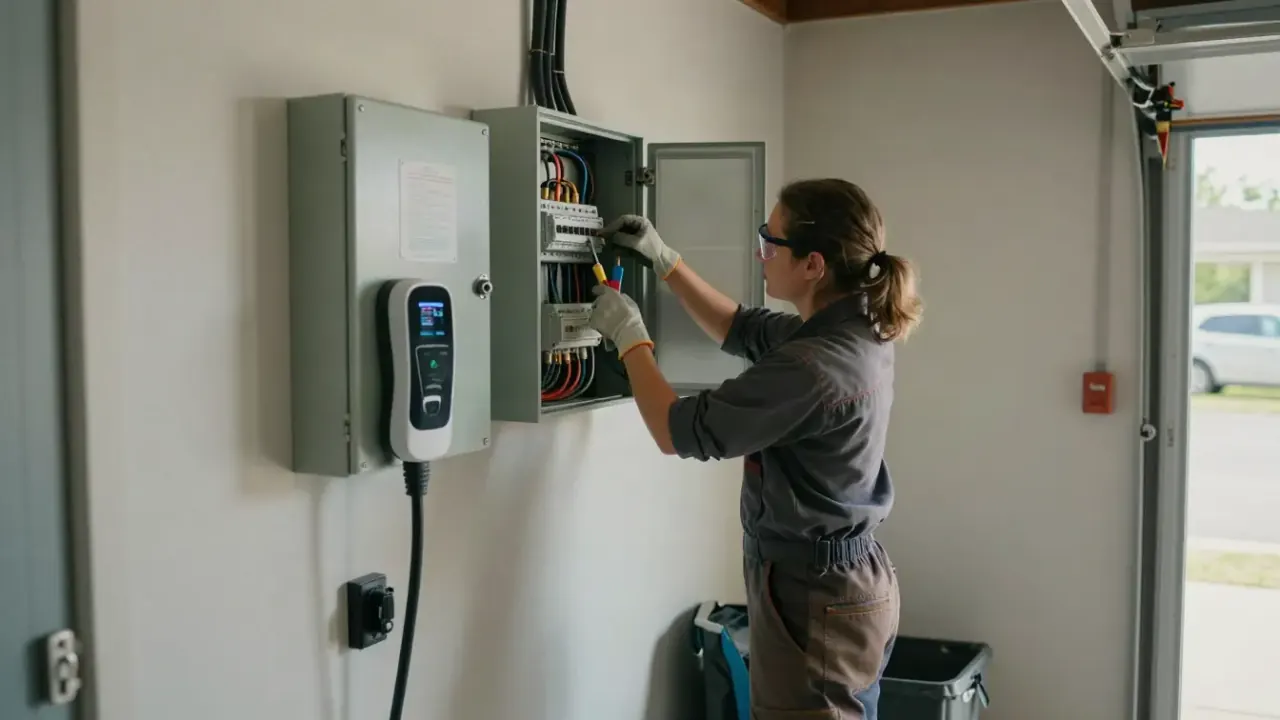
A hardwired wall charger is the better choice for most Redondo Beach homes because it delivers 40 to 48 amps continuously, removes the plug-and-receptacle connection that causes most heat-related failures, and qualifies for the full 30% federal tax credit. A NEMA 14-50 outlet is the better choice when you want to move the charger, plan to sell the house, or need a 240V receptacle for a welder or RV as well as the car. Both are legal, both are safe when installed correctly, and both will fully charge your EV overnight.
What follows is the practical breakdown we give homeowners every week in Redondo Beach: real amperage numbers, 2026 pricing, code requirements, and the specific situations where one setup clearly beats the other.
The Short Answer: Which One Wins
For a daily-driven EV that parks in the same spot every night, hardwiring wins on power, safety, and long-term reliability. A hardwired 48-amp charger adds roughly 44 miles of range per hour to a Tesla Model 3 or Y, versus about 30 miles per hour from a 40-amp charger plugged into a NEMA 14-50.
The gap matters more than it sounds. If you drive 60 miles a day, both setups recharge you fully between 11 p.m. and 6 a.m. If you drive 120 miles a day, or you own a Rivian, F-150 Lightning, or Cybertruck with a 130 kWh pack, the hardwired circuit is the difference between a full battery by morning and a partial one.
Choose the NEMA 14-50 outlet when flexibility is the priority. You can unplug the charger and take it with you when you move, swap in a different brand without an electrician, or use the receptacle for a portable EVSE, a welder, or a travel trailer. That flexibility costs you 8 amps of continuous power and one more connection point that can loosen over time.
What a NEMA 14-50 Outlet Actually Gives You
A NEMA 14-50 outlet is a 240-volt, 50-amp receptacle with four prongs - two hots, one neutral, one ground - wired to a 50-amp double-pole breaker on a dedicated circuit. Under the 80% continuous-load rule in NEC 625.42, that circuit supports a maximum of 40 amps of charging current.
In practice, that means a 40-amp Level 2 charger plugged into a 14-50 adds about 30 to 32 miles of range per hour. On a 75 kWh battery, a full charge from 20% takes roughly five to six hours.
The hardware cost is low. A quality NEMA 14-50 receptacle from Hubbell or Bryant runs $25 to $45 at a supply house. The cheap $12 big-box receptacles are the single most common failure point we replace - they are rated for a dryer that runs intermittently, not a charger pulling 40 amps for six straight hours.
You also get portability. If you lease your EV and the charger came with the car, a 14-50 lets you keep using it. If you buy a different brand later, you unplug one and plug in the other. No electrician, no permit, no inspection.
What a Hardwired Wall Charger Actually Gives You
A hardwired wall charger is a permanently connected EVSE with no plug - the electrician lands the conductors directly on the charger's terminal block. That removes the receptacle, the plug, and the two hottest connection points in the entire circuit.
Hardwiring unlocks the full 48 amps on a 60-amp breaker, which is the highest output a residential Level 2 charger can legally deliver in the US. That is roughly 44 miles of range per hour on an efficient EV, and it is the only way to get there - no plug-in charger on a 14-50 can exceed 40 amps.
It also opens up features that plug-in units cannot use. Some hardwired chargers support power sharing across two units on one circuit, dynamic load management that throttles charging when your house load spikes, and permanent Wi-Fi provisioning that survives a power outage without re-pairing.
If you drive a Tesla, the Tesla Wall Connector Installation Redondo Beach CA is almost always hardwired. The Wall Connector has no NEMA plug option at all, and it is designed to run on a 60-amp circuit at 48 amps continuous.
Is a NEMA 14-50 Outlet Better Than a Hardwired Charger in Redondo Beach?
No - for a permanent home charger in Redondo Beach, hardwiring is better in most cases. The exception is when your panel cannot spare a 60-amp breaker but can spare a 50-amp one, or when you specifically need a receptacle you can unplug.
Redondo Beach has a specific wrinkle that pushes more homeowners toward hardwiring than you would see in a newer inland city. Much of the housing stock in North Redondo, The Avenues, and the older blocks near Riviera Village was built between 1948 and 1975 with 100-amp service and a panel that is already carrying a range, a dryer, a central AC, and a pool pump.
When we run a Panel Capacity and Load Assessment Redondo Beach CA, we calculate the load per NEC 220.87 using 12 months of SCE usage data. If the service is tight, a hardwired charger with adjustable amperage - set to 32 or 40 amps - lets you stay on the existing panel where a fixed 50-amp receptacle circuit would not pass.
Coastal salt air is the other factor. Receptacle blades and plug contacts in a garage 1.5 miles from the beach oxidize faster than they do inland. A hardwired connection has no exposed blades to corrode. We see this constantly on South Redondo EV Charger Installation jobs where the garage faces the ocean and the humidity never really drops.
Cost Comparison: 2026 Pricing in Redondo Beach
Typical 2026 pricing in this area runs $650 to $1,100 for a NEMA 14-50 outlet install and $900 to $1,600 for a hardwired charger install, assuming the panel has capacity and the run is under 40 feet. The charger itself is separate: $400 to $800 for a quality Level 2 unit, or $420 for a Tesla Wall Connector.
Here is where the money actually goes:
- Circuit and wire: 6-gauge copper for a 50-amp circuit, 6-gauge or 4-gauge for a 60-amp hardwired run. Copper pricing moves, so wire is often 30% of the job.
- Labor and permit: Redondo Beach requires an electrical permit for a new 240V circuit. We pull it and handle the inspection.
- Panel work: If your panel is full, a Subpanel Installation for EV Chargers Redondo Beach CA adds $1,200 to $2,500. A full service upgrade to 200 amps runs $2,800 to $4,500.
- Run length: Every foot past 40 adds roughly $12 to $18 in materials and labor.
The 30% federal tax credit under 30D applies to both setups, but the credit caps at $1,000 and the property must be in a qualifying census tract or an eligible non-urban area. Many Redondo Beach addresses qualify. We handle the paperwork through our Permit and Utility Rebate Help Redondo Beach CA service so you are not guessing at the form.
Which Is Safer, a NEMA 14-50 or a Hardwired Charger?
A hardwired charger is measurably safer because it eliminates the plug-to-receptacle interface, which is where the overwhelming majority of residential EV charging failures occur. Every connection has resistance, and resistance at 40 amps for six hours generates heat.
The failure mode is predictable. A residential-grade 14-50 receptacle with spring contacts loosens after a few hundred plug cycles. Contact resistance climbs. The receptacle body discolors, then the breaker trips, then - in the worst cases - the box melts. This is why the National Electrical Code and most manufacturers now recommend hardwiring for any charger above 40 amps.
If you do go with an outlet, three things keep it safe:
- Use a Hubbell HBL9450A or Bryant 9450FR receptacle, not a $12 dryer outlet.
- Torque the terminals to the manufacturer spec - usually 75 inch-pounds - with a torque screwdriver. Hand-tight is not enough.
- Plug the charger in once and leave it. Repeated unplugging is what wears the contacts.
Both setups need a GFCI breaker if the receptacle is installed in a garage, per NEC 625.54. Hardwired chargers have internal ground-fault protection and do not require the breaker GFCI, which is one more reason they trip less often.
Common Mistakes We See on Redondo Beach Installs
Most problems we get called to fix trace back to one of five shortcuts. None of them are exotic, and all of them are avoidable.
- Cheap receptacle on a 40-amp load. The $12 big-box 14-50 is rated for intermittent dryer duty. It is not rated for six hours of continuous 40-amp draw. This is the number one failure we replace.
- Undersized wire. Running 8-gauge on a 50-amp circuit because it was on the truck. It will work - until it does not. Code requires 6-gauge copper for 50 amps.
- Skipping the load calculation. Adding a 60-amp charger to a 100-amp panel without doing the math is how you end up with a main breaker that trips when the AC, oven, and dryer all run at once.
- No permit. Unpermitted 240V work becomes a disclosure problem at sale and can void a homeowner insurance claim after a fire. Redondo Beach inspection is straightforward when the work is done right.
- Mounting the charger too high or too low. The connector holster should land at 48 inches so the cable does not drag on the floor or kink at the strain relief.
We also see chargers installed on the wrong side of the garage. If your car's charge port is on the driver's rear, mounting the unit on the passenger wall means the cable crosses behind the car every night. Small thing. You will notice it every day.
When to Call a Professional
Call a licensed electrician any time the work involves opening the panel, running a new 240V circuit, or adding a breaker - that is not a DIY job in California, and it is not a job for a handyman. We handle the load calculation, the permit, the install, and the inspection in one visit.
You should also call us if your existing 14-50 receptacle feels warm to the touch after charging, if the breaker has tripped more than once, or if you smell anything burning near the outlet. Those are the three signals that a connection is failing, and they get worse, not better.
If you are in a condo or townhome, the conversation is different - you need HOA approval, a metering plan, and often a shared-circuit design. Our Condo and HOA Charger Installation Redondo Beach CA team handles that paperwork and the electrical design together.
For a standard single-family home, we quote the job upfront, pull the permit, and finish most installs in a single day. We serve the whole city, from North Redondo EV Charger Installation to the hills above Knob Hill.
Frequently Asked Questions
Is a NEMA 14-50 outlet better than a hardwired charger in Redondo Beach?
No. A hardwired charger is better for most homes - it delivers up to 48 amps versus 40, has no plug connection to loosen or overheat, and runs on a 60-amp circuit. Choose the 14-50 only if you need portability or your panel cannot spare 60 amps.
Can I plug my EV charger into a NEMA 14-50 outlet in Redondo Beach CA?
Yes, as long as the outlet is on a dedicated 50-amp circuit with 6-gauge copper wire and a GFCI breaker per NEC 625.54. Use a commercial-grade receptacle rated for continuous duty, and set the charger to 40 amps maximum. Most portable and many wall chargers ship with a 14-50 plug.
Which EV charger setup is best for my Redondo Beach home?
If you park in the same spot nightly and your panel has room for a 60-amp breaker, hardwire a 48-amp charger. If your service is 100 amps, if you rent, or if you want to take the charger when you move, a NEMA 14-50 on a 50-amp circuit is the practical choice.
How much does each option cost in 2026?
In Redondo Beach, a NEMA 14-50 outlet install runs $650 to $1,100 and a hardwired charger install runs $900 to $1,600, assuming the panel has capacity and the run is under 40 feet. Panel upgrades and long conduit runs add to both.
Do I need a permit for either setup?
Yes. Redondo Beach requires an electrical permit for any new 240V circuit, whether it ends in a receptacle or a hardwired charger. The inspection is quick when the work is done to code, and we handle the permit and the inspection scheduling for you.
Get Help With EV Charger Installation in Redondo Beach
Whether you land on a hardwired 48-amp charger or a NEMA 14-50 outlet, the install has to match your panel, your parking spot, and your daily mileage. We do the load calculation, pull the permit, and finish most jobs in a day.
Call Redondo Beach EV Charger Installation at (310) 294-5464 for a quote on your home. We will tell you straight which setup fits - and if your panel needs work first, we will show you the numbers before you commit.